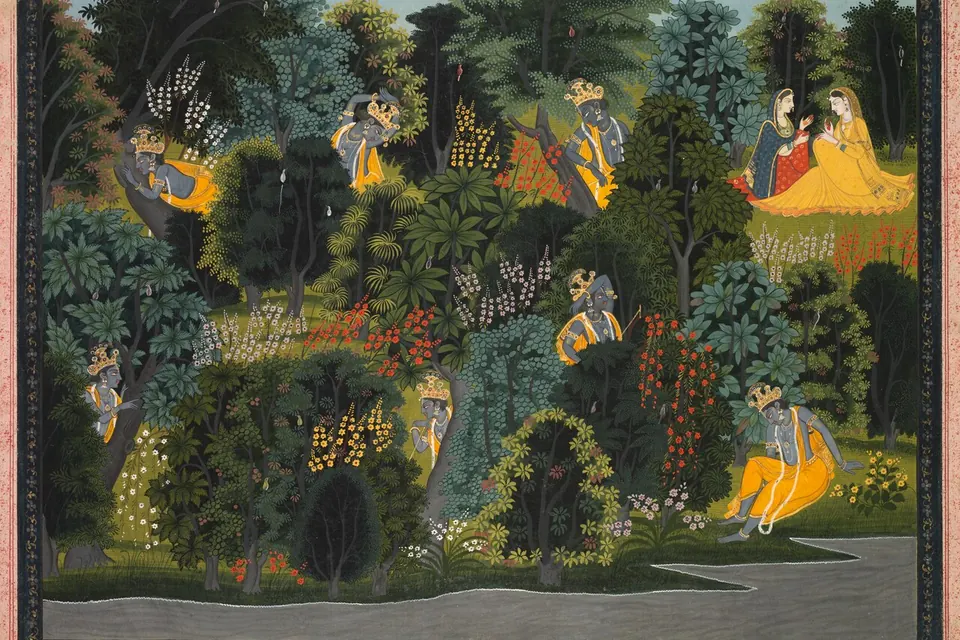
What is the Bhagavad-gita? A one-page introduction
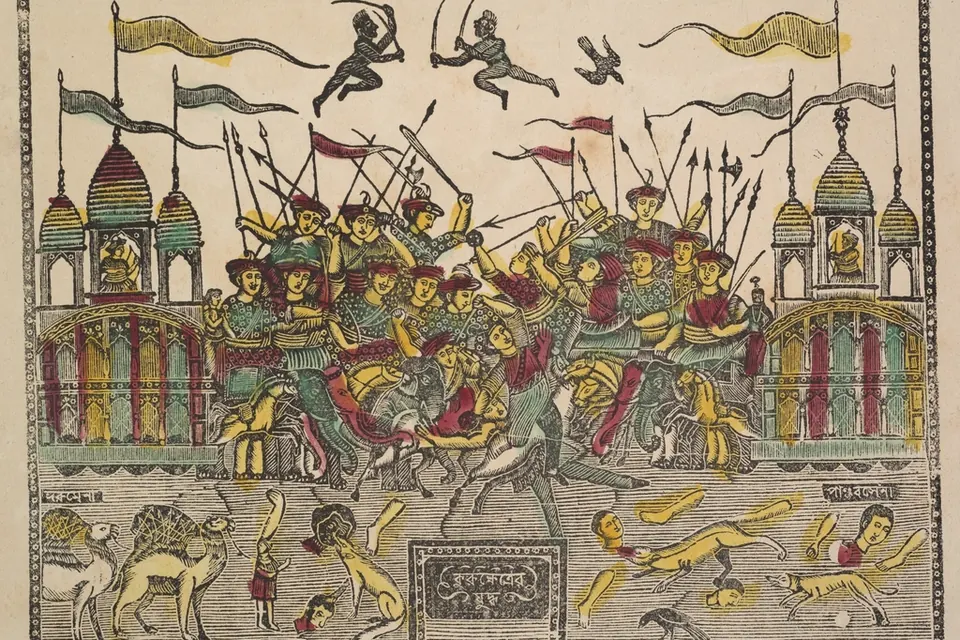
The Bhagavad-gita, "the song of the Lord", is a conversation of 700 Sanskrit verses between a warrior who does not want to fight and the friend driving his chariot, who turns out to be God. It is short enough to read in an evening and has been argued over for at least twelve centuries. This page gives the essentials in one place, for readers meeting the text for the first time.
Where the Gita comes from
The Gita is not a separate book in origin. It is an episode of the Mahabharata, the great Sanskrit epic of the war between two branches of one royal family, the Pandavas and the Kauravas. As the Internet Encyclopedia of Philosophy puts it, the Gita "occurs at the start of the sixth book of the Mahābhārata", the book of Bhishma (Bhishma Parva). Tradition attributes the whole epic to the sage Vyasa.
The scene is the field of Kurukshetra, north of present-day Delhi, just before the battle. The blind king Dhritarashtra asks his minister Sanjaya, who has been granted the power to see events far away, to describe what is happening. Everything that follows is Sanjaya's report.
Who speaks
- Arjuna, the third of the five Pandava brothers and the greatest archer of his time.
- Krishna, his cousin and friend, who has agreed to drive his chariot but not to fight. In the epic and in the text itself he is revealed as an avatar of Vishnu, or for many readers, including the Gaudiya tradition this site covers, as the Supreme Lord himself.
- Sanjaya, the narrator, and Dhritarashtra, who asks the opening question and is never heard again.
What happens
Arjuna asks Krishna to drive between the two armies. Seeing teachers, uncles and cousins ready to fight, he loses heart, drops his bow and refuses to fight, arguing that killing his own family can bring no good (chapter 1). The rest of the Gita is Krishna's answer. In chapter 2 he starts from the nature of the self, which does not die when the body dies, and from Arjuna's duty as a warrior. Over the following chapters he widens the argument into a whole account of action, knowledge, meditation and devotion, and in chapter 11 shows Arjuna his universal form. At the end Arjuna declares his doubts gone and takes up his bow.
The text runs to 18 chapters and 700 verses, a count that has been the accepted standard since the eighth-century commentary of Shankara, as the Wikipedia article on the Gita summarises. The chapters were not titled in the original; the headings found in editions were added later.
The three paths
Readers have long divided the Gita's teaching into three "yogas", or disciplines, and a scheme going back to the medieval commentator Yamunacharya divides the book into three groups of six chapters with these emphases:
- Karma yoga, the discipline of action: do your duty without attachment to its results, offering the work rather than grasping at the reward.
- Jnana yoga, the discipline of knowledge: understand the difference between the lasting self and the changing body and world.
- Bhakti yoga, the discipline of devotion: love and surrender to Krishna, which the text presents as open to anyone, whatever their birth.
Which path is highest is exactly where commentators part company. The great Vedanta teachers Shankara, Ramanuja and Madhva all wrote commentaries, and each read the Gita through his own philosophy. For the Gaudiya Vaishnavas, followers of Chaitanya, devotion is the Gita's culmination, and they point to verses such as 18.65-66, where Krishna asks Arjuna to abandon all other duties and take refuge in him. How their commentators made that case is the subject of our page on the Bhagavad-gita in the Gaudiya tradition.
How old is it?
No one can date the Gita precisely. Scholars generally place its composition in the last centuries BCE, with some arguing for the first centuries CE, and many see signs that the text grew in stages before it was fixed. The tradition itself sets the conversation at the start of the present age, the Kali-yuga, thousands of years ago. Both views agree that by the time of Shankara the 700-verse text was established.
From epic episode to world classic
For most of its history the Gita circulated with the epic and with its commentaries. Its life as a stand-alone book is more recent. The first English translation, by Charles Wilkins, appeared in 1785, and translations multiplied in the nineteenth century, among them Edwin Arnold's verse rendering The Song Celestial (1885), which we publish chapter by chapter. In the twentieth century the Gita became one of the books most often quoted from India: by Gandhi, by the physicist J. Robert Oppenheimer, who recalled a line from chapter 11 after the first nuclear test, and by the Hare Krishna movement, whose edition spread the text worldwide.
Each year, on the bright eleventh day of the month of Margashirsha, Hindus mark Gita Jayanti, the traditional anniversary of the conversation; our page on Gita Jayanti 2026 explains this year's date.
Where to start reading
- Read chapter 2 first. It states most of the themes the rest of the book develops.
- Then read straight through. The book is short; reading all 18 chapters in order takes a few hours and shows how the argument builds.
- Compare translations. No English version is neutral. A literal scholarly translation and a devotional one will differ, sometimes sharply, on the same verse.
- Use a commentary once you know the text. Commentaries explain why traditions read the same verse differently; they are easier to follow once the story is familiar.
Sources
- Internet Encyclopedia of Philosophy, Bhagavad Gītā (setting in the Mahabharata, the eighteen chapters, Vedanta commentators).
- Wikipedia, Bhagavad Gita (verse count, dating debate, English translations).
- Edwin Arnold (trans.), The Song Celestial, London, 1885, public domain, published on this site chapter by chapter.
By the Bhakti Atlas editors, 27 November 2026.