The Bhagavad-gita in the Gaudiya tradition
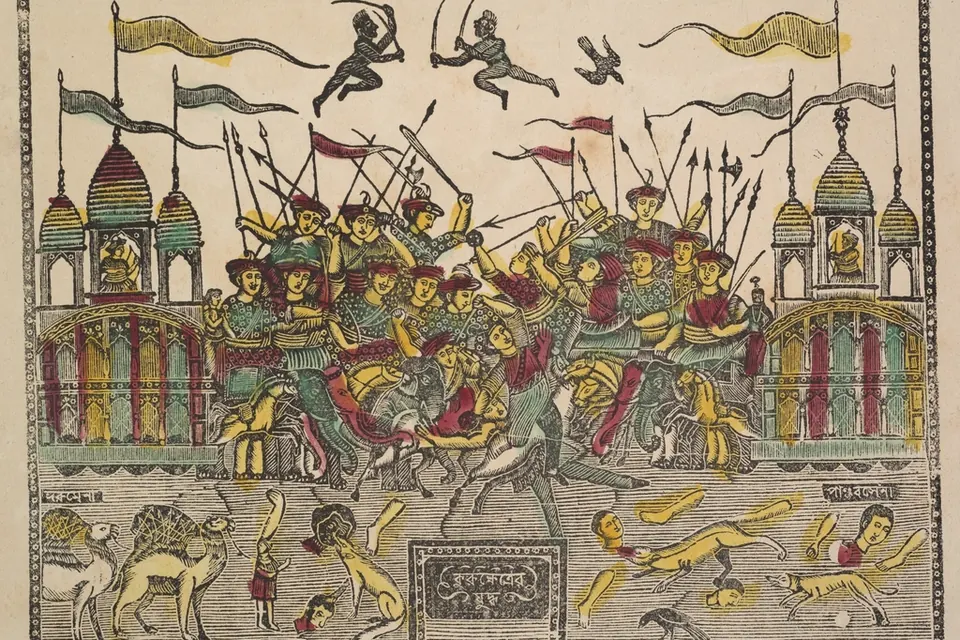
The Bhagavad-gita, "the song of the Lord", is a dialogue of seven hundred Sanskrit verses between the warrior Arjuna and Krishna, his charioteer, on the eve of the battle of Kurukshetra. It is part of the Mahabharata and is probably the most widely read Hindu scripture in the world. Gaudiya Vaishnavas read it in a particular way.
The text
The Gita occupies eighteen chapters of the Bhishma book of the epic. Most scholars date its composition to the last centuries BCE or the first centuries CE. Faced with the prospect of killing his relatives, Arjuna lays down his bow; Krishna responds with teachings on duty, the immortality of the self, disciplined action without attachment to results, knowledge, meditation and, increasingly, devotion to himself as the supreme being. In the eleventh chapter he reveals his universal form.
Because it combines several paths, the Gita has been claimed by almost every school of Indian philosophy. The non-dualist Shankara, the qualified non-dualist Ramanuja and the dualist Madhva all wrote commentaries, as did later Vaishnava teachers of many lineages.
A devotional reading
Gaudiya commentators read the whole text as leading up to devotion (bhakti), and to Krishna as a personal God rather than an impersonal absolute. Three passages carry particular weight in their reading:
- Four verses of chapter 10 (10.8–11), in which Krishna declares himself the source of everything, and describes devotees who think of him, talk of him and find joy in him. The Gaudiya tradition calls them the chatuh-shloki, the "four verses" that summarise the book.
- The end of chapter 9 (9.34) and chapter 18 (18.65–66), where Krishna asks Arjuna to fix his mind on him and to give up all other duties to take refuge in him.
- Chapter 12, which weighs worship of the formless against worship of the personal God and favours the latter.
Commentators and editions
The two classic Gaudiya commentaries in Sanskrit were written around 1700: Vishvanatha Chakravarti's Sarartha-varshini and Baladeva Vidyabhushana's Gita-bhushana, the latter written partly to show that the Gaudiya school had its own commentary on the canonical texts of Vedanta. In nineteenth-century Bengal, Bhaktivinoda Thakura published Bengali editions with these commentaries.
In the twentieth century the text became a missionary tool. Bhakti Raksaka Sridhara Maharaja published a Sanskrit and English edition with brief commentary, Srimad Bhagavad-gita: The Hidden Treasure of the Sweet Absolute, centred on the chatuh-shloki. A.C. Bhaktivedanta Swami's Bhagavad-gita As It Is, first published in abridged form by Macmillan in 1968 and in full in 1972, has been distributed in very large numbers and translated into dozens of languages; scholars have noted both its reach and its strongly theological framing. Older pages on this domain linked to a PDF edition of one of these translations, which is not reproduced here.
Gaudiya distinctives
Within the wider Vaishnava world, Gaudiya commentators stand out by stressing that Krishna is the source of Vishnu and not the reverse, and that the highest devotion is love free of calculation, an idea they connect with the Bhagavata Purana rather than with the Gita itself. They therefore often present the Gita as a beginning: it establishes devotion as the goal, while the Bhagavata describes what mature devotion looks like.
Key teachings in brief
Several ideas of the Gita recur in every commentary. The self (atman) is eternal and is not killed when the body is killed (chapter 2). One should act according to one's duty without attachment to the results, offering the action to God; this is the discipline of action, karma-yoga (chapters 2–5). The three qualities of nature, goodness, passion and ignorance, colour all of human life (chapters 14 and 17). And God, present in the heart of every being, guides those who turn to him (chapters 9, 15 and 18).
Gaudiya commentators accept all these teachings but rank them. Knowledge and disciplined action are presented as preliminary; devotion is the culmination, and the last instruction, to abandon all duties and take refuge in Krishna (18.66), is read as the final word of the book.
The Gita in Bengal
In Bengal the Gita was long read less widely than the Bhagavata Purana in Vaishnava circles. That changed in the nineteenth century, when the text became a national symbol, promoted by reformers, nationalist leaders and English-educated readers. Bankim Chandra Chattopadhyay, Aurobindo Ghose and others wrote influential interpretations. Bhaktivinoda Thakura's editions with Vaishnava commentaries were in part a response, aimed at reclaiming the text for a devotional reading. The twentieth-century Gaudiya editions continue that effort.
Reading the Gita critically
Scholars read the Gita in the setting of the Mahabharata and of the religious history of ancient India, as a synthesis of Upanishadic philosophy, Samkhya and yoga with early devotion to a personal God. Questions about its composition, its relation to the epic and its ethics of war have produced a large literature. Richard Davis's "biography" of the text traces how its readers, from medieval commentators to Gandhi and Western Theosophists, made it serve very different purposes. The Gaudiya reading is one strand in that long history.
Readers who want to see how the devotional reading continues can turn to our articles on the Brahma-samhita and on the Bhakti-rasamrita-sindhu, and to our profile of Bhakti Raksaka Sridhara, whose edition of the Gita centres on the four key verses.
Popular use
Beyond commentary, the Gita is recited, memorised and sung. Gaudiya temples hold classes on it, festivals mark the day of its teaching (Gita Jayanti) and verses are chanted in daily worship. Its distribution in printed form, especially by ISKCON, has made it one of the most widely circulated religious books in the world.
Sources and further reading
- Richard H. Davis, The Bhagavad Gita: A Biography, Princeton University Press, 2015.
- Robert N. Minor (ed.), Modern Indian Interpreters of the Bhagavadgita, State University of New York Press, 1986.
- Encyclopaedia Britannica, "Bhagavadgita": britannica.com/topic/Bhagavadgita.
- Wikipedia, "Bhagavad Gita" (orientation): en.wikipedia.org.