Gita Jayanti 2026: why it falls on 20 December, and how the day is kept
On Sunday 20 December 2026, temples and households across India and beyond will mark Gita Jayanti, the “birthday” of the Bhagavad-gita. For Gaudiya Vaishnavas the day counts twice: it is also Mokshada Ekadashi, one of the year's Ekadashi fasts (usually twenty-four). Here is what the day commemorates, how its date is worked out, why a few calendars print 19 December instead, and a simple way to keep it with the text itself.
What the day marks
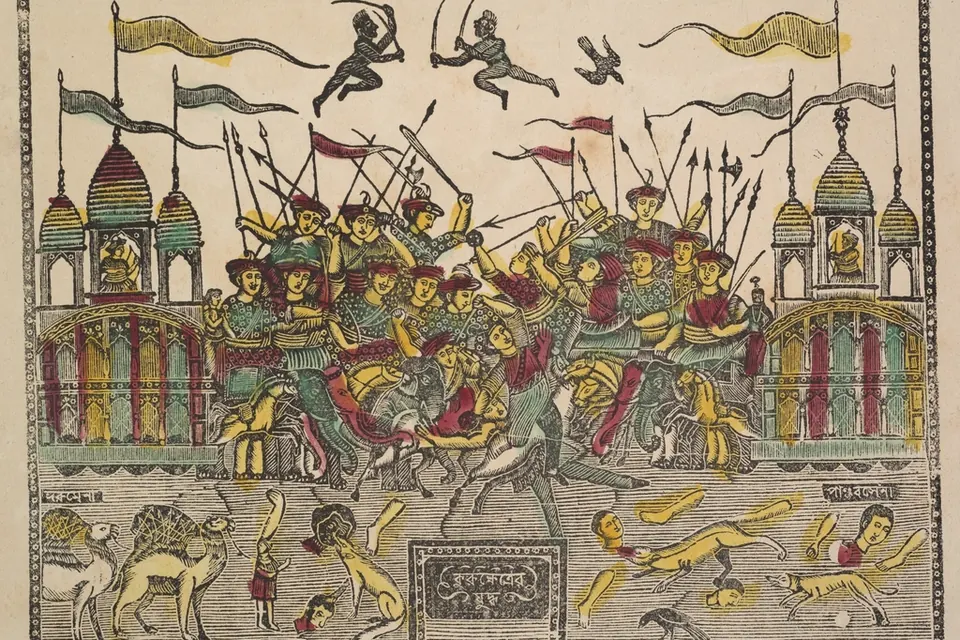
The Bhagavad-gita is set on the battlefield of Kurukshetra, in the sixth book of the Mahabharata: before the battle, Krishna answers the doubts of the warrior Arjuna in eighteen chapters of dialogue. The epic does not give a calendar date for the conversation. The tradition places it on the eleventh day of the bright fortnight of the lunar month Margashirsha (Agrahayana in Bengal), which usually falls in late November or December, and celebrates that day as Gita Jayanti.
The choice of month echoes the Gita itself. In the tenth chapter, where Krishna lists the things in which he is most fully present, he says that among the months he is Margashirsha; Edwin Arnold's Victorian translation renders the line as “Of months the Margasirsha” (chapter 10 on this site).
In the Vaishnava calendar the same eleventh day carries the fast called Mokshada Ekadashi, “the Ekadashi that grants liberation”. The two observances are kept together: a day without grains and beans, given to reading, recitation and chanting. The online encyclopedia entry on Mokshada Ekadashi summarises the Puranic story usually told about the fast.
Why 20 December in 2026
Hindu festivals follow lunar days, or tithis, which do not start at midnight. A tithi lasts as long as the Moon takes to gain twelve degrees on the Sun, between roughly nineteen and twenty-six hours, and it can begin at any hour. In 2026 the Ekadashi tithi of Margashirsha begins on 19 December at about 22:09 Indian time and ends on 20 December at about 20:14, according to the astronomical calculation behind our Ekadashi calculator. The almanac site PanchangBodh and others give the same window to within a few minutes.
Vaishnava calendars then apply a simple rule: the fast is kept on the civil day whose sunrise falls inside the Ekadashi tithi, provided the previous tithi is no longer running at dawn. On 19 December the tithi has not yet started at sunrise anywhere; on 20 December it is running at sunrise in India, in Europe and in North America. Our calculator therefore gives Sunday 20 December for Mayapur, Vrindavan and Kurukshetra, but also for London, Paris and New York.
Why do some calendars print Saturday 19 December? Festival almanacs do not all use the sunrise rule for every observance, and their result depends on the place they are set for. When we consulted it, Drik Panchang, set by default to a location in the United States, listed Gita Jayanti on 19 December 2026, with the tithi beginning on the morning of the 19th, local time. For anyone who keeps the fast, the practical advice does not change: follow the calendar of your temple or tradition, which may also apply the further Gaudiya rules our calculator leaves out.
At Kurukshetra: a three-week festival
The largest public celebration takes place where the tradition sets the dialogue. Since 2016 the government of Haryana has organised an International Gita Mahotsav at Kurukshetra, around the great tank of Brahma Sarovar, with craft fairs, recitations, seminars and evening ceremonies on the water. The 2025 edition ran for twenty-one days, from 15 November to 5 December, with its main programme from 24 November to 1 December, as The Tribune reported from Kurukshetra.
For 2026, the Haryana government has announced celebrations from 5 to 25 December, again centred on Brahma Sarovar, with Delhi and West Bengal as partner states and a procession from Pipli on 4 December (summary of the announcement, 31 October 2026). Gita Jayanti itself, on 20 December, falls inside that window. Pilgrims also visit Jyotisar, a few kilometres from the town, where a banyan tree is traditionally pointed out as the spot where the Gita was spoken.
Keeping the day with the text
Whatever one's calendar, the heart of Gita Jayanti is the book. Reading all eighteen chapters in one day is a common way to keep it, and it is less daunting than it sounds: the Gita has some seven hundred verses, a few hours of steady reading aloud. For those who prefer a shorter path, here is a plan built on our chapter pages, each with a short introduction:
- Morning: the crisis and the answer. Chapter 1, Arjuna's despair, and chapter 2, where Krishna begins to teach: the immortality of the self and action without attachment to its fruits.
- Midday: devotion. Chapter 12, the shortest and for the Gaudiya tradition one of the most important, on loving devotion (bhakti) and the qualities of the devotee.
- Evening: the conclusion. Chapter 18, which gathers the teaching and ends with Krishna's call to take refuge in him, a verse Gaudiya commentators often single out as the summit of the whole text.
Our overview of the Bhagavad-gita in the Gaudiya tradition explains how Chaitanya's followers read the book, and why Arnold's 1885 verse translation, which we publish in full, is a poem of its time rather than a literal rendering. Readers who want the Sanskrit alongside a modern translation will find many editions; those of the tradition's own teachers are discussed in our profiles of A.C. Bhaktivedanta Swami and Bhaktisiddhanta Sarasvati.
In short
- Date: Sunday 20 December 2026 (Ekadashi tithi from 19 December, about 22:09, to 20 December, about 20:14, Indian time).
- Same day: Mokshada Ekadashi, a fast from grains and beans; check your temple's calendar for the exact day and the time to break the fast.
- Some almanacs set for American locations print 19 December.
- Kurukshetra: International Gita Mahotsav, 5 to 25 December 2026, at Brahma Sarovar.
- To keep it: read the Gita, in full or in a few key chapters.
By the Bhakti Atlas editors, 23 November 2026.