Abhay Charan De's Calcutta: family, childhood and early years
The future founder of ISKCON spent the first half of his life as Abhay Charan De, a son of north Calcutta. This article draws on published biographies to describe that background. It replaces an older page at this address that carried an interview with a relative; we do not reproduce that interview or attribute statements to living family members.
A merchant family
Abhay was born on 1 September 1896. His father, Gour Mohan De, was a cloth merchant of the Suvarna-vanik community, a Bengali mercantile caste; his mother was Rajani. According to the authorised biography, he was born in Tollygunge, in the south of the city, and grew up in the family home on Harrison Road (now Mahatma Gandhi Road) in north Calcutta. The family was related to the Mullicks, wealthy merchants who maintained a temple of Radha-Govinda opposite the house.
His father is described as a devout Vaishnava of modest means who encouraged his son's interest in worship and music. Hagiographic accounts make much of this upbringing, but even scholarly writers note that it gave Abhay a lifelong familiarity with temple ritual, Bengali devotional song and the mridanga drum.
A childhood chariot festival
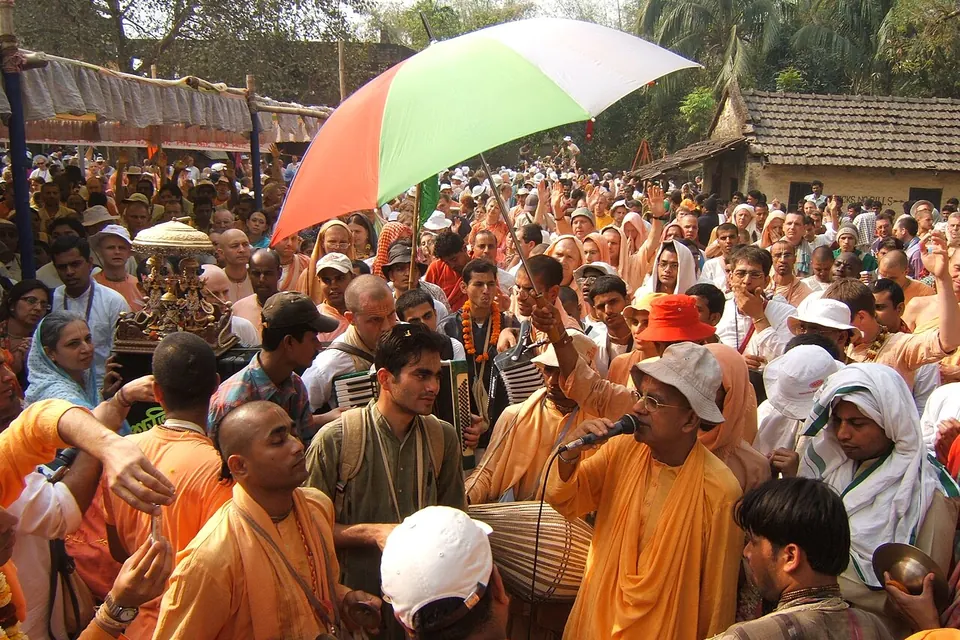
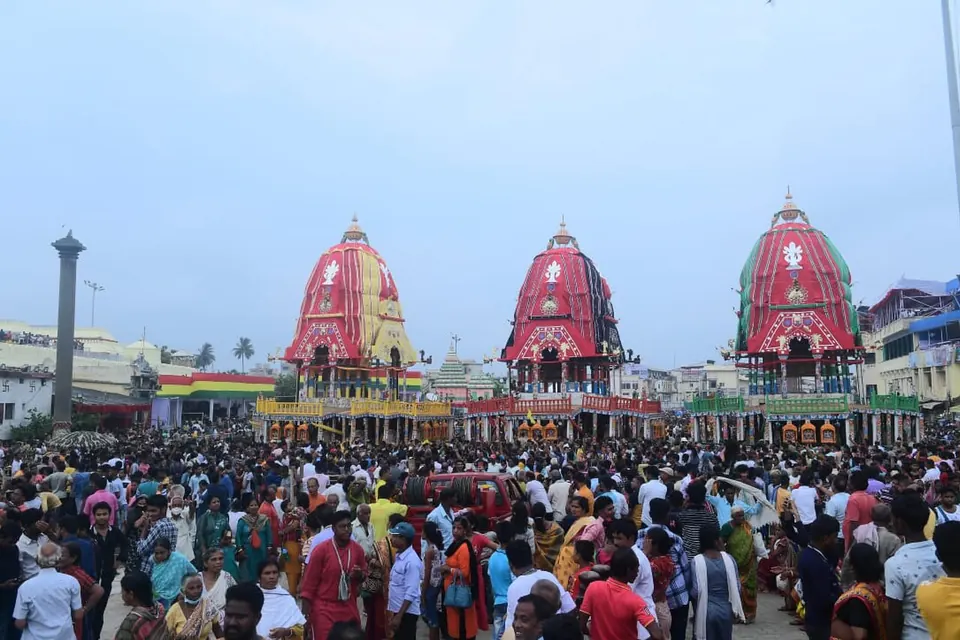
One episode recurs in every biography. As a small boy, Abhay asked his father for a chariot so that he could hold his own Ratha-yatra, like the one he had seen in the neighbourhood. His father had a small cart made, and the children of the lane pulled it, with images of Jagannath, in a festival that was repeated for several years. Biographers present the story as an early sign of the processions he would later lead in San Francisco, London and New York.
School, college and politics
Abhay studied at the Mutty Lal Seal Free School and then at the Scottish Church College, a prominent missionary institution, where he read English, philosophy and economics. Calcutta at the time was a centre of nationalist politics, and like many students he was drawn to Gandhi's non-cooperation movement. The biographies report that in 1920 he declined to receive his degree as a gesture of support for the boycott of British institutions.
He had married Radharani Datta while still a student, in a marriage arranged by the two families, and the couple had several children.
Into business
After college he became manager of a chemical and pharmaceutical firm in Calcutta, then set up his own pharmacy business, which took him to Allahabad in the 1920s. It was in Calcutta, in 1922, that a friend took him to meet Bhaktisiddhanta Sarasvati; Abhay would later describe that meeting as the turning point of his life. He was initiated in Allahabad in 1933, while still running his business.
His commercial career was uneven, and by the 1950s he had largely withdrawn from it to devote himself to writing and publishing, the story continued in our profile of A.C. Bhaktivedanta Swami.
A note on sources
Almost everything known about Abhay's early life comes from accounts written by his followers, above all the six-volume biography by Satsvarupa dasa Goswami, based on interviews and on his own recollections. Academic historians have relied on these sources with caution. Family members have occasionally given interviews to devotional publications; such accounts are part of the record but have not been independently verified.
The Suvarna-vanik world
The Suvarna-vaniks, traditionally gold merchants and bankers, were among the trading communities that prospered in Calcutta under British rule. Many families were Vaishnava, maintained household shrines and sponsored temples, festivals and the feeding of pilgrims. The Mullicks of north Calcutta, to whom Abhay's family was related, are a well-known example: their temples and mansions still stand in the old neighbourhoods near the Hooghly. Growing up in this milieu meant growing up close to temple worship, to the Bengali devotional songs of Narottama Dasa and Bhaktivinoda, and to festivals such as the chariot procession of Jagannath.
The community's social position was ambiguous. Wealthy and urban, it ranked relatively low in the Brahmanical hierarchy, a fact that some historians connect with the attraction of such families to Vaishnava teachings that downplayed caste. Bhaktisiddhanta Sarasvati's insistence that devotion, not birth, defined a Brahmin would later resonate with many disciples from similar backgrounds.
A city in ferment
Abhay's youth coincided with major changes in Calcutta. The partition of Bengal in 1905 provoked the Swadeshi movement, with boycotts of British goods and a surge of nationalist feeling among students. The capital of British India moved to Delhi in 1911. In 1920–22 Gandhi's non-cooperation campaign asked Indians to withdraw from government schools, courts and honours. The Scottish Church College, where Abhay studied, was itself a product of the missionary and reformist currents of the nineteenth century, and its alumni included figures such as Swami Vivekananda.
These circumstances help explain the meeting of 1922. According to the biographies, Abhay first argued with Bhaktisiddhanta that India needed political independence before spiritual teaching could be heard; Bhaktisiddhanta replied that spiritual knowledge could not wait for politics. The anecdote is told by followers, but it reflects a real debate of the period about the relation between religion and nationalism.
Family and renunciation
Abhay remained a householder for most of his life. His business moved between Allahabad, Calcutta and later Bombay and Delhi, with mixed fortunes. The biographies describe growing tension between his family obligations and his wish to publish and preach, which led him in the early 1950s to withdraw from family life. He took the vows of renunciation in 1959, at the age of 63. Members of the De family and their descendants continued to live in Kolkata, and some have spoken publicly about their relationship to him; the sources for those accounts are devotional publications rather than independent research.
Sources and further reading
- Satsvarupa dasa Goswami, Srila Prabhupada-lilamrta, vol. 1, A Lifetime in Preparation, Bhaktivedanta Book Trust, 1980.
- Edwin F. Bryant and Maria L. Ekstrand (eds.), The Hare Krishna Movement, Columbia University Press, 2004, introduction.
- Encyclopaedia Britannica, "A.C. Bhaktivedanta Swami Prabhupada": britannica.com.