Shri Rupa-manjari-pada: Narottama Dasa's song of the handmaid
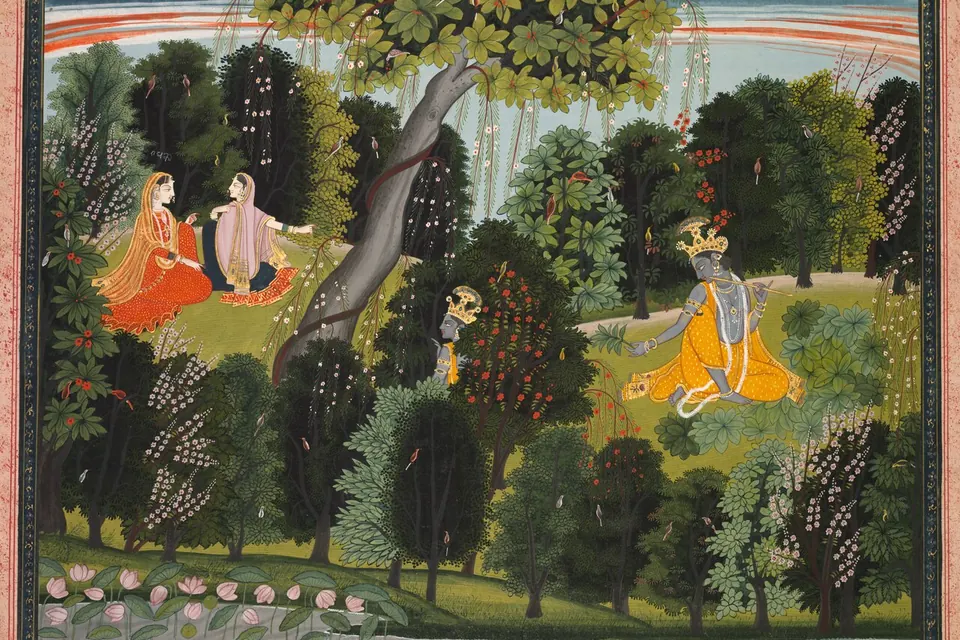
Shri Rupa-manjari-pada, "the feet of Shri Rupa Manjari", is one of the best-loved songs of the Gaudiya repertoire. Written in Bengali by Narottama Dasa Thakura in the late sixteenth century, it is addressed not to Krishna or Radha but to one of Radha's young attendants. An older page at this address carried the song with a modern commentary; this article explains it in our own words.
The poet
Narottama Dasa (sixteenth century) was the son of a landowning family of Kheturi, in what is now Bangladesh. He went to Vrindavan, studied under Jiva Gosvami and was initiated by Lokanatha Gosvami. Back in Bengal he organised the festival at Kheturi, around 1580, that brought together the scattered followers of Chaitanya and helped standardise their worship and their music. His Bengali songs, collected in the Prarthana and the Prema-bhakti-chandrika, are still sung daily in temples, and he is credited with founding the garanhati style of kirtan.
Who is Rupa Manjari?
In Gaudiya theology, Radha is surrounded by girlfriends (sakhis) and by younger handmaids called manjaris, "buds" or "sprigs". The manjaris do not seek Krishna's love for themselves; their joy is to serve and arrange the meetings of Radha and Krishna. The tradition identifies Rupa Gosvami, author of the Bhakti-rasamrita-sindhu, with Rupa Manjari, the leader of these handmaids in the eternal world.
The song therefore carries two meanings at once. On the surface, it is a prayer to a figure in Krishna's play. In the tradition's reading, it is also a prayer to Rupa Gosvami as a teacher, asking for the kind of devotion he described.
What the song says
The opening line, shri rupa-manjari-pada, sei mora sampada, declares that the feet of Rupa Manjari are the poet's treasure. The following verses heap up images: they are his worship, his wealth, his life and ornament, the object of his meditation. The final verses express the hope of serving under her guidance, and conclude with Narottama's signature, as is customary in Bengali song.
Like much of Narottama's poetry, the song is short, rhymed and easy to memorise, but dense with references to the theology of raganuga bhakti, devotion that follows the feelings of the residents of Vraja.
Rupanuga: following Rupa
The song is a key text for what Gaudiya teachers call the rupanuga line, the tradition of "those who follow Rupa". Twentieth-century authors in the Gaudiya Math, notably Bhaktisiddhanta Sarasvati and Bhakti Raksaka Sridhara, used the term to define the authentic Gaudiya identity against what they saw as imitative or sentimental practice. Sridhara wrote a short commentary on the song, explaining it as the highest aspiration of the devotee; that commentary is not reproduced here but has been published by his math.
How it is sung
The song is usually sung in a slow devotional melody, to the accompaniment of hand cymbals (kartals), the double-headed clay drum (khol or mridanga) and often harmonium. It belongs to the repertoire of evening programmes and of festivals commemorating Rupa Gosvami. Recordings by many singers, including the American kirtan leader Vishnujana Swami, have helped carry it beyond Bengal.
The manjari ideal in context
The idea of serving as a handmaid of Radha grew out of the sixteenth-century literature of Vrindavan. Rupa Gosvami's works describe the companions of Radha in detail, and later authors developed meditation manuals in which the practitioner imagines an eternal identity as a young maidservant, with a name, age, colour of dress and particular service. This practice, called manjari-bhava, became central to the esoteric side of Gaudiya devotion. Narottama's songs are among its earliest and most popular expressions in Bengali.
The ideal has been the subject of debate within the tradition. Some groups made the meditative identity the core of practice from the moment of initiation. Others, including the Gaudiya Math, insisted that it should arise only after long purification, and warned against premature imitation. Commentaries on Shri Rupa-manjari-pada often reflect these positions, treating the song either as a guide to meditation or as an expression of aspiration that the singer has not yet earned.
A song among others
The song belongs to a group of Narottama's compositions addressed to teachers and companions rather than to the divine couple directly. Others in the same spirit praise Lokanatha Gosvami, his own guru, or ask for the mercy of the Vaishnavas. Together they illustrate a principle of Gaudiya devotion: access to Radha and Krishna passes through those who already serve them. This mediated structure distinguishes the tradition from forms of devotion in which the worshipper addresses God directly.
In practice, the song is often sung on the anniversaries of Rupa Gosvami's birth and passing, in temples of the Vrindavan area and in the many communities that trace their lineage through Rupa. Its simple metre has lent itself to new melodies in the twentieth century, and recordings exist in Bengali kirtan style, in Hindi devotional style and in Western arrangements.
Listening to the song today
Because the song is short and well known, it is often the first Bengali text that newcomers to Gaudiya communities learn by heart, sometimes before they know the language. Printed songbooks usually give the Bengali in transliteration with a line-by-line translation. Readers interested in its theology can turn to Rupa's own works, introduced in our article on the Bhakti-rasamrita-sindhu, and to the wider history told in our article on the Six Gosvamis.
Sources and further reading
- David L. Haberman, Acting as a Way of Salvation: A Study of Raganuga Bhakti Sadhana, Oxford University Press, 1988.
- Edward C. Dimock Jr. and Denise Levertov (trans.), In Praise of Krishna: Songs from the Bengali, Doubleday, 1967.
- Tony K. Stewart, The Final Word: The Caitanya Caritamrta and the Grammar of Religious Tradition, Oxford University Press, 2010, on Kheturi and Narottama.
- Wikipedia, "Narottama Dasa" (orientation): en.wikipedia.org.