Kalki: the avatar of the end of the age
Of the ten avatars of Vishnu in the classical list, nine are placed in the past. The tenth, Kalki, is still to come. He is expected at the end of the present age, the Kali-yuga, to bring a corrupt world to an end and open a new age of truth.
A page under this address once carried a traditional account of Kalki. This is a new article on the texts and images associated with him.
An age in decline
Hindu cosmology describes time as a cycle of four ages (yugas) of decreasing length and virtue: Satya, Treta, Dvapara and Kali. The Kali-yuga, said in the Puranas to last 432,000 years, began according to the traditional reckoning in 3102 BCE, at Krishna's departure from the world. Texts such as the twelfth book of the Bhagavata Purana describe it in vivid terms: rulers become robbers, wealth replaces virtue, religion becomes outward show, lifespans shorten.
What the texts say
The Bhagavata Purana lists Kalki among the avatars in its first book (1.3.25) and returns to him in the twelfth (12.2.18–20). He will be born in the village of Shambhala, in the house of a Brahmin named Vishnuyashas. Riding a swift white horse named Devadatta and carrying a sword, he will destroy the thieves who pass for kings, after which the minds of the people will be purified and the Satya age will begin again.
Earlier versions of the Kalki story appear in the Mahabharata and the Vishnu Purana. A later text, the Kalki Purana, probably composed in Bengal in the early modern period, develops it into a full romance, with Kalki's marriage, battles and travels.
Jayadeva's Gita Govinda (twelfth century) gives him the last verse of its hymn to the ten avatars, praising him for wielding a sword like a comet to destroy the barbarians.
Images of Kalki
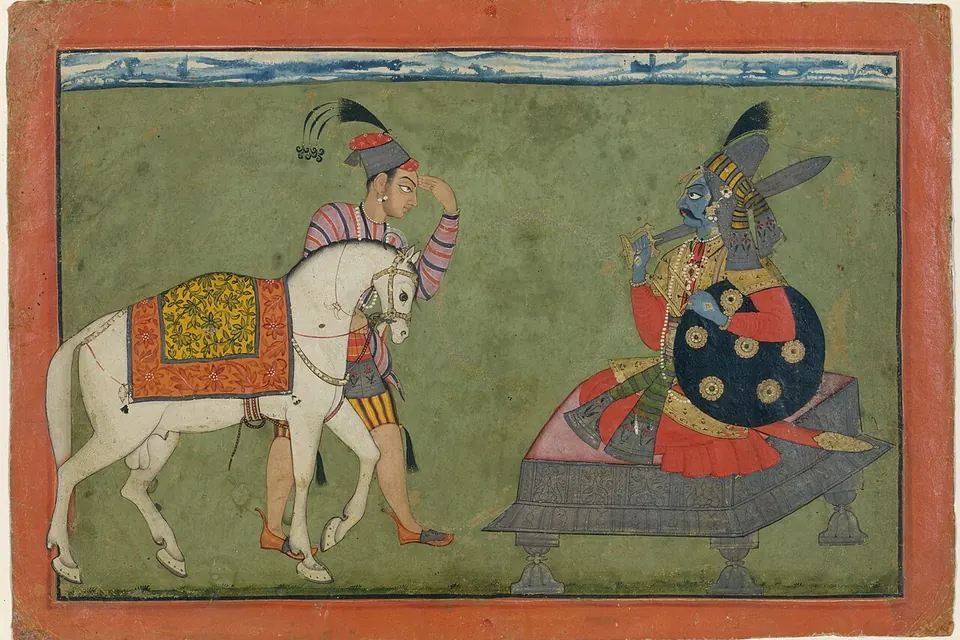
In painting and sculpture Kalki is shown in two main ways: as a warrior riding a white horse with sword raised, or as a horse-headed figure. In some Rajasthani and Pahari series the white horse alone stands for him, sometimes with one hoof raised, ready to strike the earth. The Metropolitan Museum page reproduced above shows the white horse beside the armed avatar.
Gaudiya readings
Gaudiya Vaishnava authors accept Kalki as a future avatar but give him far less attention than Krishna and Chaitanya. They often stress a passage of the Bhagavata (12.3.51–52) that sees a hidden virtue in the Kali age: what was obtained in earlier ages through meditation, sacrifice or temple worship can now be obtained simply through chanting the names of God. In this reading, the age before Kalki is also the age of the holy name, the context in which Chaitanya's movement placed itself.
Modern uses
The figure of a coming deliverer has proved adaptable. Various modern religious leaders in India have presented themselves, or been presented by followers, as Kalki; Indian popular culture has used the name for films and novels; and some writers in the nineteenth and twentieth centuries set Kalki alongside messianic figures in other religions. Scholars treat these as examples of how a classical myth keeps being reinterpreted.
The Kali age in Gaudiya teaching
For Gaudiya Vaishnavas the description of the Kali age is not only a prophecy but a diagnosis of the present. Teachers from Chaitanya's biographers to the twentieth-century missions cite the Bhagavata's list of the age's faults, such as short lives, quarrels and the decline of learning, to argue that complex rituals and long meditations are no longer practical. The remedy they propose is the chanting of divine names, identified in the Kali-santarana Upanishad with the sixteen-word Hare Krishna mantra. Chaitanya's movement, in this reading, is the special grace of the age, appearing long before Kalki's final intervention.
The Gaudiya tradition also speaks of a "golden age" within the Kali age, a period of some ten thousand years after Chaitanya during which the chanting of the names will spread worldwide. This idea, found in texts of disputed date cited by Bhaktivinoda Thakura, was important for twentieth-century missionaries who saw their work as its fulfilment.
Kalki in the Dashavatara series
In sets of paintings of the ten avatars, Kalki is the last image and often the most striking: a white horse in a landscape, sometimes riderless, sometimes mounted by a crowned figure with a raised sword. Rajput and Pahari painters of the eighteenth century produced many such series for royal patrons; museums in India, Europe and the United States hold examples. In temple sculpture, Kalki usually appears at the end of a frieze of the avatars around doorways or on ceilings.
Dating the end of the age
Calculations of when the Kali age began and ends have varied. The traditional epoch of 3102 BCE was used by Indian astronomers from at least the time of Aryabhata in the fifth century. With a length of 432,000 years, the age has far to run, and most Vaishnava authors place Kalki in a remote future. Groups that announce his imminent arrival therefore depart from the classical texts; scholars of new religious movements have documented several such cases in modern India.
For readers interested in the other end of the avatar list, our article on the Buddha as an avatar discusses the ninth form and the history of the list itself.
Kalki and Chaitanya
Gaudiya authors sometimes contrast the two figures. Kalki ends the age by force; Chaitanya, in their view, offers a peaceful remedy within it through the holy name. This contrast appears in commentaries and sermons as a way of presenting Chaitanya as the hidden avatar of the present age, a claim supported in the tradition by verses of the Bhagavata Purana interpreted as referring to him.
Sources and further reading
- Encyclopaedia Britannica, "Kalki": britannica.com/topic/Kalki.
- Wendy Doniger, The Hindus: An Alternative History, Penguin, 2009, on the yugas and Kalki.
- Barbara Stoler Miller (trans.), Love Song of the Dark Lord: Jayadeva's Gitagovinda, Columbia University Press, 1977.
- Wikipedia, "Kalki" (orientation): en.wikipedia.org.