The Buddha as an avatar of Vishnu
In most Vaishnava lists of the ten principal avatars of Vishnu, the ninth is the Buddha. The idea that the founder of a rival religion was a descent of Vishnu is one of the more surprising features of Hindu theology, and it has been explained in very different ways.
A page under this address once presented a traditional account of the "Buddha avatara". This is a new article on the subject.
Where the idea appears
The Buddha appears in several Puranas from around the middle of the first millennium CE onwards. In the Bhagavata Purana's first list of avatars (1.3.24), he is said to appear at the beginning of the Kali age, in the region of Kikata (generally taken to mean Magadha, in today's Bihar), as the son of Anjana, in order to bewilder the enemies of the gods. The parentage differs from the Buddhist account, in which the Buddha is the son of Shuddhodana and Maya, and scholars debate whether the Puranic Buddha was originally meant to be the same figure.
The most famous statement comes in the twelfth century. Jayadeva's Gita Govinda opens with a hymn to the ten avatars, the Dashavatara-stotra, sung across India to this day. Its verse on the Buddha praises Vishnu for taking that body out of compassion for animals, condemning the Vedic rites in which they were sacrificed. Each verse ends with the refrain keshava dhrita…sharira jaya jagadisha hare, "O Keshava, who took the form of…, victory to you, lord of the world".
A list that varies
The canonical ten avatars (Matsya, Kurma, Varaha, Narasimha, Vamana, Parashurama, Rama, Balarama or Krishna, Buddha and Kalki) were not fixed everywhere. Some lists put Krishna in the ninth place and omit the Buddha; others include Balarama. Gaudiya Vaishnavas, who regard Krishna as the source of all avatars rather than one among them, usually follow Jayadeva's list, with Balarama as the eighth and the Buddha as the ninth.
How Vaishnava authors explained it
Explanations divide broadly into two lines:
- A deceptive mission. Some Puranic passages describe the Buddha as leading the wicked or the demons away from the Vedas, so that they would lose their power. In this reading the Buddha's teaching is a deliberate illusion.
- A compassionate reform. Jayadeva's verse, and many later commentators, stress compassion: the Buddha came to stop violence in the name of ritual, preparing people for higher teaching. Gaudiya authors of the twentieth century generally favoured this reading, presenting the Buddha's non-violence as a necessary stage in human spiritual history.
Both explanations share an assumption that the Vedic and Vaishnava revelation is the frame within which the Buddha has a place, which is precisely what Buddhists reject.
Historians and Buddhists
Historians generally see the inclusion of the Buddha among the avatars as part of a long process in which Brahmanical religion absorbed popular figures and rival movements, at a time when Buddhism was declining in India. Some Buddhist writers have regarded the avatar doctrine as an appropriation of their teacher; others have treated it as a sign of respect. In modern India the idea has been invoked in very different contexts, from interfaith gestures to political debates over sites such as Bodh Gaya.
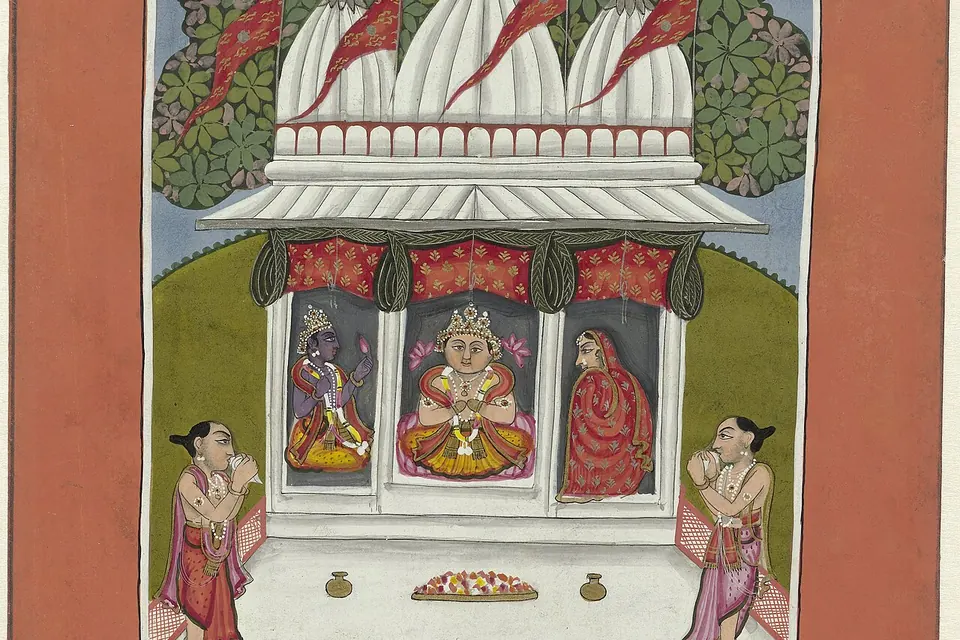
The Rijksmuseum drawing above, from a series of the avatars, shows the Buddha in the iconography familiar to Indian viewers of the time: seated, serene, in a royal pavilion, a quite different image from the Buddhist statues of the same period.
The avatar idea
The word avatara means "descent". Vaishnava theology holds that Vishnu descends into the world in many forms whenever religion declines, a principle stated in the Bhagavad-gita (4.7–8). Early lists vary widely in length: the first book of the Bhagavata Purana names twenty-two avatars, and then adds that they are innumerable, like streams flowing from an inexhaustible lake. The list of ten became standard in medieval India through texts such as the Gita Govinda and through temple art, where the ten forms are carved on doorways and painted in series like the one shown above.
Gaudiya theology adds its own distinction. Following the Bhagavata verse that says "Krishna is the Lord himself" (1.3.28), Gaudiya authors treat Krishna not as one avatar among others but as the source of all of them. The Buddha, like the other nine, is therefore understood as a partial manifestation with a specific mission.
A Gaudiya reading in detail
Twentieth-century Gaudiya writers, including authors in the Gaudiya Math tradition such as Bhakti Ballabh Tirtha, generally accept both the Puranic account and Jayadeva's emphasis on compassion. In their presentation the Buddha's rejection of the Vedas was strategic: people who used Vedic authority to justify killing animals could only be stopped by a teacher who set that authority aside. Non-violence and ethical discipline prepared the ground for later teachers who, in this view, would restore the Vedas with a devotional reading. Gaudiya authors usually place Shankara, the eighth-century philosopher of non-dualism, as the next step in this sequence, and Chaitanya as its culmination.
This scheme is a theology of history, not a historical claim, and it is not shared by Buddhists. It is nonetheless typical of the way Gaudiya teachers of the colonial and post-colonial period tried to place other Indian traditions within their own narrative.
In art and festival
Images of the Buddha as an avatar appear in temple sculpture from the early medieval period and in painted sets of the ten avatars made for Hindu patrons from the seventeenth century onwards. In some regions, notably Odisha, Jagannath himself has been identified with the Buddha in local traditions and in modern scholarship, a debated question discussed in our article on Jagannath Puri. The Dashavatara hymn of the Gita Govinda is sung daily in the Jagannath temple and in Odissi dance performances.
Sources and further reading
- Barbara Stoler Miller (trans.), Love Song of the Dark Lord: Jayadeva's Gitagovinda, Columbia University Press, 1977.
- Wendy Doniger O'Flaherty, The Origins of Evil in Hindu Mythology, University of California Press, 1976, chapter on the Buddha avatar.
- Encyclopaedia Britannica, "avatar": britannica.com/topic/avatar-Hinduism.
- Wikipedia, "Gautama Buddha in Hinduism" (orientation): en.wikipedia.org.