Gopal Guru Gosvami and the Radhakanta Math of Puri
Among the companions of Chaitanya remembered in Puri, Gopal Guru Gosvami holds a special place: tradition makes him the first head of the Radhakanta Math, the monastery that preserves the Gambhira, the room where Chaitanya is said to have spent his last years. An older page at this address told his story; this is a new account.
A name given in jest
Gopal Guru is said to have come to Chaitanya's circle as a boy, in the house of Kashi Mishra, the priest who hosted Chaitanya in Puri. Gaudiya hagiography tells that the boy, though young, once corrected an elder on a point of devotion, and that Chaitanya, amused, called him "guru", a name that stayed with him. He became a disciple of Vakreshvara Pandita, one of Chaitanya's associates known for his singing and dancing in kirtan.
The stories about him come mostly from later Bengali and Oriya sources, and dates are uncertain. Historians generally place his active life in the middle and late sixteenth century.
The Radhakanta Math
After Chaitanya's death in 1534, the house of Kashi Mishra became a place of memory for his followers. Gopal Guru is credited with establishing worship there of an image of Krishna called Radhakanta, which gave the institution its name. The Gambhira, a small inner room, is still shown to pilgrims, together with objects said to have belonged to Chaitanya, such as his wooden sandals and water pot.
The Radhakanta Math remained a monastic centre run by a succession of heads, distinct from the later twentieth-century missions from Calcutta. It is one of the main stops on any visit to the Chaitanya sites of Puri.
Dhyanachandra and the meditation manuals
Gopal Guru's best-known disciple and successor, Dhyanachandra Gosvami, is remembered as the author of a manual of meditative worship (paddhati) describing how a practitioner visualises and serves Chaitanya and Radha-Krishna in a spiritual setting. Texts of this kind, attributed to Gopal Guru and to Dhyanachandra, were important in the development of smarana, the practice of inner remembrance in which the devotee imagines a role in the divine play. Scholars such as David Haberman have studied this tradition of meditative practice.
Why he matters
Gopal Guru's story illustrates how Chaitanya's movement put down roots in Puri after his death: not through a single organisation but through households, small monasteries and lineages that kept memories of particular places. For historians, the Radhakanta Math is also a reminder that the Gaudiya tradition has always included an Oriya strand alongside the better-known Bengali and Vrindavan communities.
Vakreshvara Pandita
Gopal Guru's teacher, Vakreshvara Pandita, appears in the Chaitanya-charitamrita and the Chaitanya-bhagavata as one of Chaitanya's companions in Navadvipa and later in Puri. He was famed for his dancing during kirtan; the biographies describe him dancing for hours before the chariot of Jagannath. He is counted among the associates who followed Chaitanya to Puri and remained there, forming the nucleus of an Oriya branch of the movement. Through Gopal Guru, his line continued at the Radhakanta Math.
Chaitanya's companions in Puri
The Puri community around Chaitanya included Bengali devotees who travelled each year for the chariot festival and residents of Odisha attached to the king's court and the temple. Among the latter were Ramananda Raya, a governor and poet whose conversations with Chaitanya on devotion fill a chapter of the Chaitanya-charitamrita, and Sarvabhauma Bhattacharya, a scholar of logic and Vedanta who became a follower. Kashi Mishra, the priest in whose house Chaitanya lived, belonged to this local circle. After Chaitanya's death in 1534 some of these households and their disciples kept his memory alive in Puri, while the Gosvamis in Vrindavan developed the theology and Bengali leaders organised the movement in Bengal.
The house of Kashi Mishra today
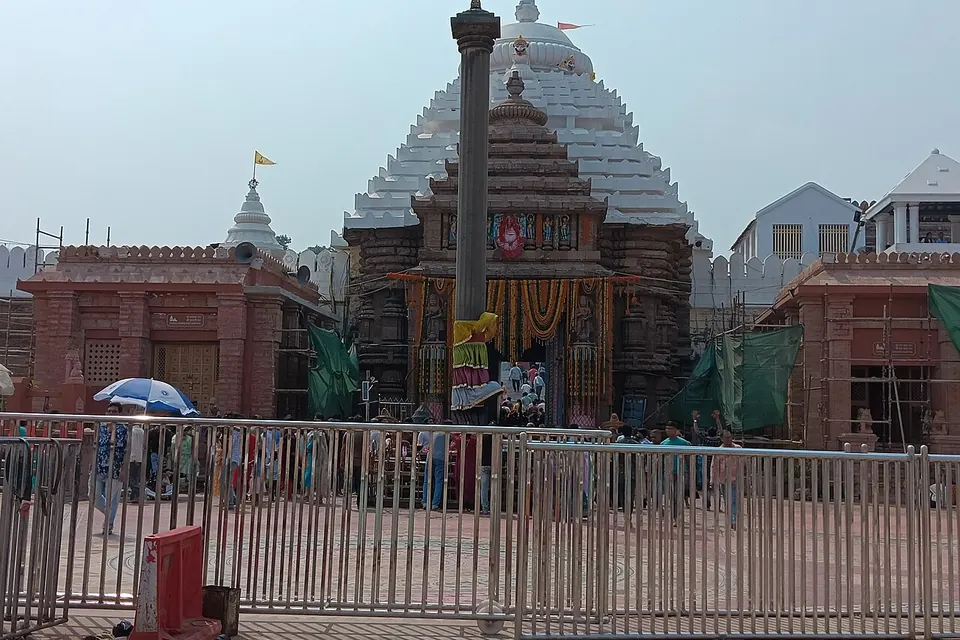
The Radhakanta Math lies a short walk from the Jagannath temple. Pilgrims visit the Gambhira to see the room associated with Chaitanya's last years, described in the final chapters of the Chaitanya-charitamrita as a period of intense longing in which he spent nights in ecstatic states, attended by his secretary Svarupa Damodara and by Raya Ramananda. The math also holds the image of Radhakanta whose worship tradition attributes to Gopal Guru. Visitors should note that, as in many old institutions in Puri, access to parts of the building may be limited.
Reading the hagiographies
Most of what is told about Gopal Guru comes from devotional literature written long after his lifetime, and from the traditions of the Radhakanta Math itself. Such sources are valuable for understanding how a community remembers its founders, but historians use them with care: anecdotes are often shaped to illustrate a teaching, and dates and family details are rarely confirmed by independent evidence. Twentieth-century collections of lives of Chaitanya's associates, such as those by Bhakti Ballabh Tirtha, retell these traditions for a modern audience.
What can be said with more confidence is that the Radhakanta Math existed as an institution by the seventeenth century, that it preserved a lineage traced to Vakreshvara Pandita, and that manuals of meditative worship circulated under the names of its early heads. These facts make it one of the oldest continuous Gaudiya institutions in Odisha.
Further reading on this site
The wider context of Chaitanya's years in Puri is told in our article on Chaitanya, and the temple town in our guide to Jagannath Puri.
Among the other Chaitanya sites of the town, the Radhakanta Math is the one most directly tied to his daily life, which explains its importance for pilgrims from Bengal and beyond.
Sources and further reading
- David L. Haberman, Acting as a Way of Salvation: A Study of Raganuga Bhakti Sadhana, Oxford University Press, 1988.
- Bhakti Ballabh Tirtha, Sri Chaitanya: His Life and Associates, Mandala Publishing, 2001 (traditional account).
- S.K. De, Early History of the Vaishnava Faith and Movement in Bengal, 2nd ed., Firma K.L. Mukhopadhyay, 1961.