Jagannath Puri: a guide to the temple town and its Chaitanya sites
Puri, on the Bay of Bengal in the Indian state of Odisha, is one of the four great pilgrimage centres (dhamas) of Hinduism and the home of Jagannath, "Lord of the World". For Gaudiya Vaishnavas it has a second meaning: it is where Chaitanya spent most of his adult life.
This page replaces an older photo essay on Puri that was published at this address. It is a new, illustrated introduction to the town for readers interested in its history and its place in the Gaudiya tradition.
The temple and its builders
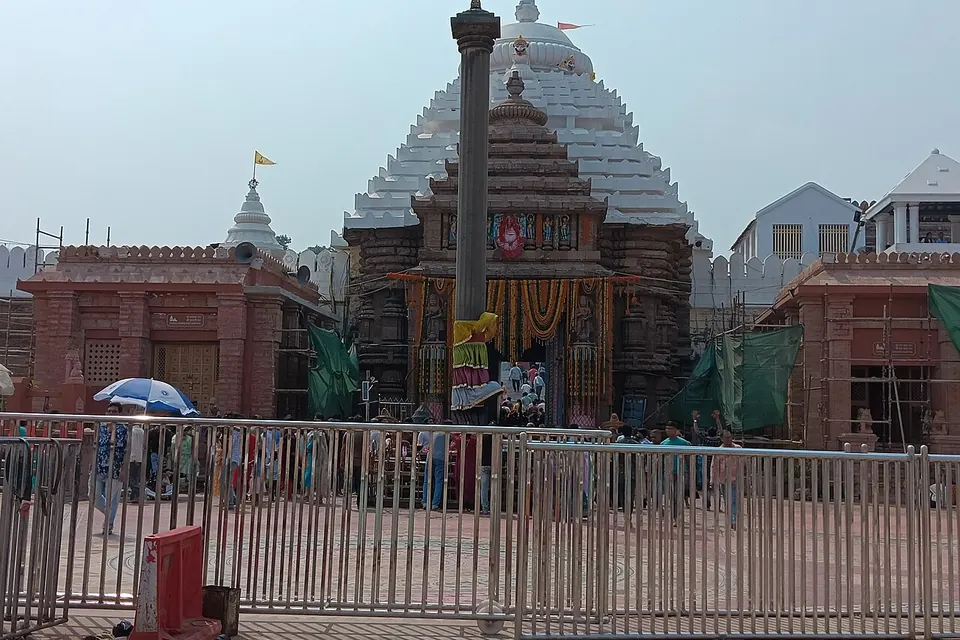
The present temple, known locally as the Shrimandira, was begun in the twelfth century under Anantavarman Chodaganga of the Eastern Ganga dynasty and completed by his successors. Its main tower (deula) rises to about 65 metres and is crowned by a metal wheel, the nila-chakra, and a flag changed every day. The complex is enclosed by two concentric walls and holds well over a hundred smaller shrines, kitchens and halls.
Four gates open onto the four directions. The eastern Lion Gate (Simhadvara) faces the broad Grand Road (Bada Danda) and is the main entrance; before it stands the Aruna Stambha, a monolithic pillar brought from the Sun temple at Konark in the eighteenth century. The others are the Horse, Tiger and Elephant Gates. Entry to the temple itself is restricted to Hindus, a rule the temple administration still enforces; visitors who cannot enter often view the tower and the flag from neighbouring rooftops.
The deities
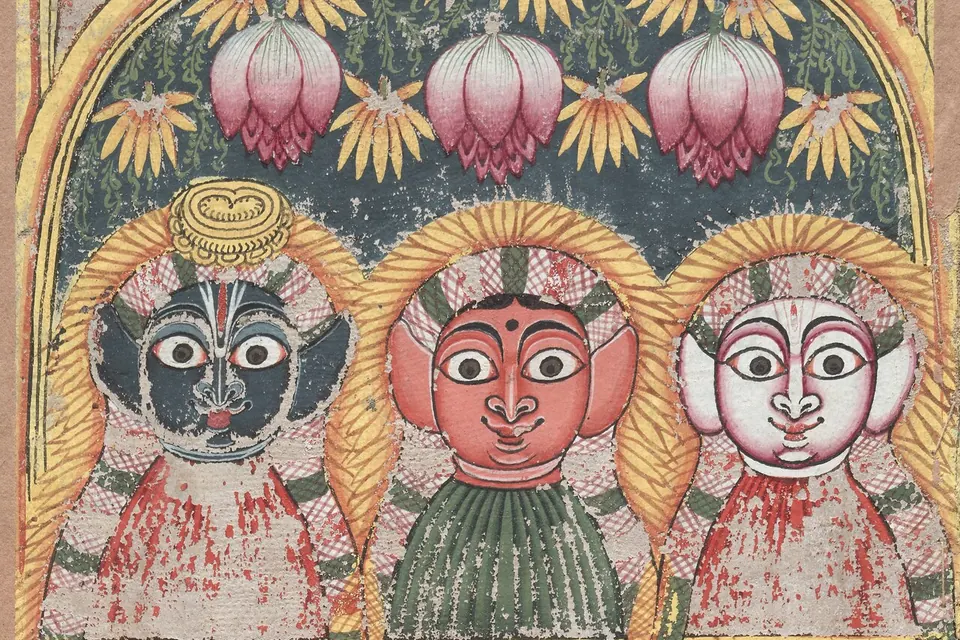
Jagannath is worshipped together with his elder brother Balabhadra and his sister Subhadra, and with the Sudarshana, a wooden pillar representing Vishnu's discus. The images are carved from neem wood and have large round eyes and abbreviated arms, a form unlike the classical sculpture of most Indian temples. Historians have long debated its origins, which may combine tribal, Shaiva, Buddhist and Vaishnava elements; the temple tradition itself explains the form through the legend of King Indradyumna and the divine carpenter who left the images unfinished.
Because the images are wooden, they are periodically replaced in a secret ceremony called Nabakalebara ("new body"), held in years with a double lunar month of Ashadha. The most recent took place in 1996 and 2015.
A calendar of festivals
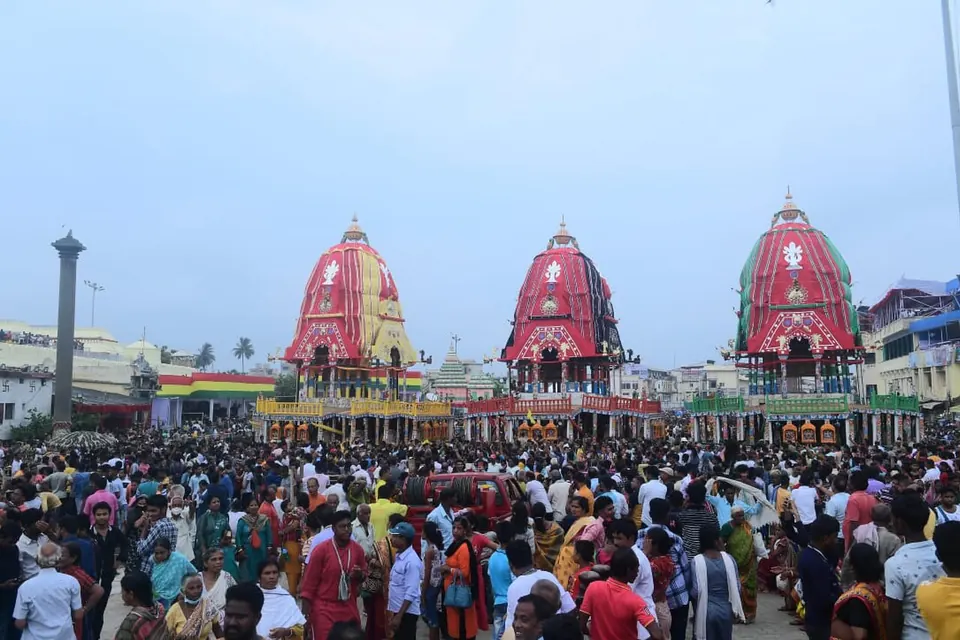
The temple's ritual year is crowded. The best known festival is the Ratha-yatra, when the three deities ride huge wooden chariots along the Grand Road to the Gundicha temple, about three kilometres away. It is preceded by the Snana-yatra, a public bathing of the images, after which they are kept out of view for about two weeks. In spring the Chandana-yatra takes festival images out on boats on the Narendra tank for three weeks of evening outings.
The temple kitchen, said to be one of the largest in the world, cooks food offered to Jagannath in earthen pots over wood fires. The sanctified food, mahaprasad, is sold at the Ananda Bazar market inside the compound and is shared without the caste restrictions observed elsewhere, a point often noted by observers since the colonial period.
Chaitanya in Puri
Chaitanya arrived in Puri soon after taking the vows of a renunciant in 1510. After travelling in South India and, briefly, towards Vrindavan, he settled in the town and stayed until his death in 1534. His biographers, above all Krishnadasa Kaviraja in the Chaitanya-charitamrita, describe his daily visits to the temple, his ecstatic dancing before the chariots and his circle of companions. Several sites in Puri are associated with those years:
- The Gambhira. A small room in the house of Kashi Mishra, a temple priest, where Chaitanya is said to have lived during his last years. The house now belongs to the Radhakanta Math, whose early history is linked to Gopal Guru Gosvami.
- Siddha Bakula. A garden with an old bakula tree where Haridasa Thakura, a companion of Muslim birth who did not enter the temple, chanted the holy names; his tomb lies by the sea.
- Tota Gopinatha. A temple near the shore whose image of Krishna as Gopinatha was worshipped by Gadadhara Pandita, another close associate.
- The Gundicha temple. Chaitanya and his followers are remembered for washing and cleaning it before the chariot festival, a ritual re-enacted by pilgrims today.
- Narendra Sarovara. The large tank used for the boat festival, where the biographies place scenes of shared bathing and singing.
How far each identification rests on early evidence varies. Some, such as Kashi Mishra's house, are mentioned in sixteenth- and seventeenth-century sources; others were fixed or rebuilt by later communities. Most were renovated in the twentieth century by Gaudiya institutions from Calcutta.
Visiting today
Puri is about 60 kilometres from Bhubaneswar, the state capital, and is served by road and rail. The temple is run by a statutory administration under the Shri Jagannath Temple Act of 1955, with the Gajapati, the former king of Puri, retaining ceremonial duties. Photography is not allowed inside the compound. The Ratha-yatra brings several hundred thousand visitors to the town and is best planned well in advance.
Gundicha, Alarnatha at Brahmagiri and Sakhigopal, three nearby temples tied to the Jagannath cult and to Chaitanya, are located on the map of our pilgrimage places atlas.
Puri and the kings of Odisha
From the twelfth century, the rulers of Odisha presented themselves as servants or deputies of Jagannath, who was regarded as the true sovereign of the kingdom. The Gajapati kings of the fifteenth and sixteenth centuries, including Prataparudra, Chaitanya's contemporary and patron according to the Gaudiya biographies, maintained this ideology. The ritual sweeping of the chariots by the king during the Ratha-yatra is its most visible survival. Historians such as Hermann Kulke have described this "royal cult" as a key to Odisha's political history.
Sources and further reading
- Anncharlott Eschmann, Hermann Kulke and Gaya Charan Tripathi (eds.), The Cult of Jagannath and the Regional Tradition of Orissa, Manohar, 1978.
- Encyclopaedia Britannica, "Puri" and "Jagannatha": britannica.com/place/Puri-India.
- Krishnadasa Kaviraja, Chaitanya Charitamrita, trans. Edward C. Dimock Jr., Harvard Oriental Series, 1999.
- Wikipedia, "Jagannath Temple, Puri" (orientation): en.wikipedia.org.